Wednesday, June 16, 2010

Are the Republicans Dancing on Their Own Grave?

Republicans and non-Republicans who consider themselves centrists, many of whom voted Democratic in 2008, are giddy at the exposure of Barack Obama as a poor president and kind of a lame-o guy generally.  

I can't join them.  The giddiness seems premature to me.  I'm still working out why, but this is my site, so I'm going to try to work it out here at my typical overlength.

My concern is that the President's opponents may not invest their recent gains wisely.  They are showing signs of being entirely capable of plowing their unexpected windfall into a dot-com IPO.

I can't put my finger on this; perhaps you can help me out.   It'll help if I ramble some.

I was one of those people who believed that the last general election presented us with a choice between a flashy, amateur fraud (+ punch-line running mate) and a conventional, predictable fraud (+ ditto).  I held my nose and voted for the latter, but the former won.  Flashy is sexy.  Flashy is fun.

But he was still a fraud, a well-spoken mediocrity, and it is no surprise that his inexperience in sustaining a fraud on a national scale has resulted in even many of his star-stunned supporters turning on him.  So the current piling on is, in some ways, great fun to observe. 

OK, we're getting there -- it's the fun that's bothering me.  Here's an example:  A few days ago, I came upon an article on The American Thinker website called "The Smallest President" by Geoffrey P. Hunt.   It was a corker.  Let me quote a few tasty passages:

     "Would someone remind us again why the nation elected this man to be president? A man with no resume, a man with no experience in running anything other than a political campaign, a man who is ignorant of history, economics, and technology? A man who is shallow and lazy? A man who shares neither character nor temperament with the American people in this vast republic? How did this happen?

     "Only a partisan or a fool could deny the irredeemable failure of these ideological handmaidens, the genius of Obama's shrinking presidency.

     "In utter exasperation, the citizens of Arizona finally took matters into their own hands, only to be vilified by Obama and his cohorts, who have neither the will nor the capacity to do anything about it.

     "Those who use the currency of identity politics appeal to the ideals of justice and fair distribution of resources and outcomes. But in reality they prey on those who are underprivileged and dependent, making claims of dispossession against those who have enjoyed success and independence derived from their own sweat, equity, and competence.

     "Identity politics combined with incompetence have exposed the absurdity in the ambitions of big government and made Obama the weakest, most anemic and flaccid president in the modern era."

Yes, this is rhetoric, but it's great rhetoric.  I agree with most of it.  (Although I would argue that it's tough to beat Jimmy Carter for weakness, anemia, and flaccidity.)   It's delicious.  And deeply satisfying to those of us who have mistrusted Barack Obama and his fickle media acolytes since the instant he announced his candidacy.

But recently, pieces like Mr. Hunt's, as schadenfreud-y as they are, have started to bother me.

Gloating over the President's tiny profile isn't going to get us anywhere.    Let me ask you to assume for the moment what no less an observer than Peggy Noonan assumed in her piece a week or so ago and what I somewhat more nervously predicted in a couple of recent posts -- this administration is almost already finished.  It imploded in record time, scarcely a year from inauguration.  (And somehow, the President has even managed to take something that was manifestly neither his nor his administration's fault, the BP Gulf Spill, and turn it into the occasion for a demonstration of how being a community organizer and running a large political campaign doesn't prepare a president for dick squat when it comes to leadership, resolve, or action.)   The administration has plenty of time to right itself, but as I have written here and here, I don't think President Obama gives a Rahm's ass about his electoral legacy, and I don't see him shedding his titanic self-regard to admit that his course is inimical to American freedom, not to mention common sense.  I don't think he's going to take his foot off the gas as he continues to execute his hard left.  And he'll keep going right into Poucha Pond.

Well, that's what I would like to think, anyway.  But when I see the reaction of the center and the right to the President's woes, I wonder.  After I read pieces like Mr. Hunt's -- and there are dozens upon dozens of articles like them these days -- I think: 

Enough already.   Fun is fun, but where is it getting us?

The Republicans seem to have short memories, but I suspect that the electorate will not.  It wasn't very long ago that we were all appalled at the indirection, diffidence and incoherence of the Bush Administration.  President Obama continues to remind us of this, and it's an intelligent strategy.

This is the answer to Mr. Hunt's opening question:   We ended up electing this man to be president because we were so unhappy with the lazy, dithering twit we'd had for eight years that we voted against his party and ended up with a twit who is even lazier and whose dithering makes Bush look positively resolute.

So I'm thinking that it's time for those who oppose the President to stop the piling on.  The runner is down; it's fourth and long for POTUS.   It's time for us to figure out what we're going to do when we get the ball back. 

The question people like Mr. Hunt and the Tea Party people and the disaffected centrists and I need to be asking ourselves is -- whatta we got?  With whom are we going to repopulate Congress and the Oval Office?  What are the values and beliefs we are looking to associate with the political class with whom we hope to replace the Democrats? 

It is not enough, and it is wrong, to say "limited government people" or "family-values people" or "God-fearing people," or "people closest in spirit to the Tea Party movement."  But that's what the opposition is starting to look like.  It is offering us people like Sarah Palin and Rand Paul and pappy Ron, and others who appear to be beholden to the Tea Partiers, and I am here to tell you ladies and gentlemen of good sense and moderate good will, although it may feel good to scratch that anti-government itch right now, if what you put up against Barack Obama and the Democrats has no more going for it than that, by 2012 you will find yourselves in the outer darkness for four more years.

Because upon the electorate's mature reflection, it will prefer the urbane moderate-sounding special-interest huckster to the reactionary peckerwood. 


Or, not to put too fine a point on it:  Voters will prefer someone who sounds smart to someone who sounds dumb.  (George Bush is not a counterexample.  Albert Gore and John Kerry, in addition to not sounding smart themselves, had weird and oddly repellent personalities.  And there are those who would say that Gore did win that election.)

The country leans conservative but it does not lean crazy.  It leans toward the centrality of personal responsibility but it does not lean toward meanness.  It is as nervous about the self-certainty of fundamentalist Christians as it is about that of fundamentalist Muslims.  It does not believe that government is inherently evil.  Candidates who talk as though they do begin very soon to sound deranged. 

Let's take Sarah Palin.  Now I happen to like quite a lot about Sarah Palin and I would probably agree with most of what she has to say.  But look deep into your souls and your brains, Tea Party people, and tell me -- do you want to see Sarah Palin debate Barack Obama?  Do you want the country to see her say, in such a debate, what she recently said to Bill O'Reilly -- that our "founding documents" are "quite clear that we would create law based on the God of the Bible and the 10 commandments, it’s pretty simple."  

And the Bible would say what, exactly, about credit default swaps?  British Petroleum?  the border with Mexico?  the space program?  Affirmative action?   Wealth transfer from the rich to the poor?  Well?

And yet we see Ms. Palin with very respectable poll numbers among Republicans.  And I can't help but think the reason is that it feels so, so good to stick it to the smarmy, elitist, arrogant, fact-evading, redistributionist Democrats by supporting someone way the hell the other side of the spectrum, saying to the odious Pelosis and Reids you're so wrong that we're going to support someone who is against everything you're for just because you're for it

That's uh  .  .  .  reactionary.

It's not my intention to demonize Ms. Palin, or Christians.  I voted for her presidential ticket and might find it necessary to do so again.  But that ticket lost.  It lost to one that sounded one helluva lot smarter, and with Joe Biden on that ticket that's not saying much for the ticket I voted for.   When the time comes to sweep Washington clear of its current ideological rubble, we should be looking for women and men who are for something, who are willing to acknowledge that government has a role to play in making our lives better, that the free market isn't good at stopping ecological disasters, that intelligent immigration policy is good for the economy -- you see where I'm going. 

Formulating a coherent, forward-looking set of policies isn't as much fun as bashing Barack Obama.  And I'm all for continuing to document his errors and infirmities.  But in the meantime, we need to resist the tendency to answer the demagoguery of the godless left with demagoguery of the Christian right.

We need to be positive, and we need to be smart.  And we need to sound like both.

I feel a little better, thanks.

Wednesday, June 9, 2010

The Worst KFC Store in the Galaxy, and the Next One Over

I have discovered the secret of the universe and am preparing an entry to disclose it to you.  But this is more important.

I have the superseding moral duty to call to your attention the Worst KFC Store Ever before another hungry citizen is subjected to its awfulness.  It is located in Frisco, Texas, at 7560 Preston Road, just north of the Rolater/Stonebrook intersection, hard by Kroger's and a Sonic.  The following event, which is not even the most infuriating consumer experience that I have suffered at this appalling establishment, took place today.
When the Memsahib is at a professional conference out of town I have implied permission to return to my pre-Memsahib habits (culinary only).  I had started work at 4:30 that morning and had left work early to run a couple of errands, which concluded a few minutes before 5:00 this afternoon.  I decided to have some Kentucky Fried Chicken and a styrofoam bucket of that sweet cole slaw and perhaps a serving of mashed potatoes made from the Colonel's secret recipe consisting entirely of nonorganic reconstituted potato by-products rendered palatable by watery gravy whose salt content is calibrated to match that of the Colonel's Original Recipe 11 Secret Herbs and Spices, five or six of which are probably some isotope of sodium chloride.  

I had some doubts that I would be successful in this quest.  I had not had good success in purchasing fried chicken products at this particular KFC, the only one convenient to my path home, and, oddly, the only one in Frisco, a rather large municipality.  Do any of you recall the Monty Python cheese-shop sketch, where John Cleese attempts to purchase cheese at a cheese shop operated by Michael Palin, but the shop seems to have no cheese of any variety available? 


(You may view it here.)   

That's the way I felt as I entered the Frisco KFC -- but I always think, no, surely this time they will be able to complete a consumer fried-chicken transaction.   So I enter, step right up to the counter, and place my usual order -- the eight piece dinner, Original Recipe, with the aforementioned slaw and spuds as the sides.  Two each of breast, wing, drumstick, and thigh.  About eighteen bucks.  The pleasant young woman who took my order called a special offer to my attention -- ten legs and thighs and three sides and a tank-car sized drink for only fifteen bucks, the difference being accounted for by KFC's desire to sell the less desirable dark pieces, since the larger white-meat breasts are preferred by customers who purchase by the piece.  (You just know that some people order breasts instead of thighs claiming they're less fatty, which is like justifying petting a water moccasin instead of a panther because it's smaller.)  In this way, KFC may maintain a more favorable statistical balance in their inventory of the various salable parts of the chicken which they assemble into the white-and-dark dinner buckets and the like.   Ah, but what KFC Corporate does not know is that I actually prefer dark meat, so the all-legs-and-thighs promotion + extra side + bladder-busting drink was a steal for me -- I'd have paid more than fifteen bucks for it.   Ha.

But I had been deceived by this particular KFC before.  On many occasions.

I thought the auspices were favorable, however.  Bear in mind -- I looked at my watch -- it was 4:55 p.m.  What most fast-food franchises would refer to as "the beginning of the dinner hour," or what Bronco's Hamburgers, where I used to work in Bellevue, Nebraska, would have called "rush."   You know, when customers were expected.  To come in to the store.  And order Kentucky Fried Chicken.

And it was the beginning of that time.  There was no rush at that time.  No uncontrollable demand for fried chicken that would push those pools of hot grease up to and beyond their chicken-frying limits, causing delays in completing fried-chicken sales.  No -- all signs for fried-chicken availability were positive.  There were a handful of customers in the store, some of whom were eating fried chicken (a very hopeful sign right there), some of whom were attempting to decipher the menu choices, and some of whom appeared to be plotting meth deals.  But I was the only one in line to order.  Cars were beginning to enter the lot, and some people had come in behind me.  But I was there,standing at the counter at that first blush of fried-chicken-purveying commercial activity.

Still, I found it necessary to ask the nice young woman:  "Do you have dark Original Recipe chicken ready to go?"

"Oh, yes," she said, betraying no impression that my question was in any way unusual.

"Sold," I said.

And she left to busy herself assembling my order.

After a minute, she returned with a portly young man with irregular facial hair.  His shirt said "assistant manager."  They seemed rather sad.  "I'm sorry," the young woman said.  "We  have no dark Original." 

"None?" I asked.  I was prepared to compromise, as one must at this shop.

The young man spoke.  "One piece."

Now consider that in addition to it being the beginning of the dinner hour, the store was promoting an all-dark chicken special calling for the provision of multiple pieces of dark-meat fried chicken in a store that holds itself out as selling almost exclusively fried chicken, of which Original Recipe is the most popular, as it is the  recipe that has brought millions of people to KFCs in preference to other fast-food joints for decades.

I had already filled this enormous vat -- I mean, it wasn't a cup, it was almost a barrel, with a handle and everything -- with my gallon or so of free drink.  And I had been deucedly clever about it; I got the Hawaiian Punch with no ice, which I could take home and slurp out of for days without worrying about loss of fizz or dilution by melted ice.

"How long?" I asked.

"Eighteen minutes," the irregularly-haired assistant manager said.

In other words, they didn't even have any Original Recipe thighs or drumsticks in process.  Some poor jamoke was probably back there frantically starting to shovel half-breaded chicken parts into the deep-fat fryer.

And so I'm standing there like an idiot with this bucket of lukewarm Hawaiian Punch and this irregularly-haired portly kid telling me that, at 5 PM on this fine, fine late-Spring afternoon of June 9, Year of Our Lord 2010, in the only KFC store in a city of over 100,000 souls, in a part of the country that is not known for its insistence on a healthy diet, located on the most heavily trafficked road in that city, at one of its most heavily-trafficked intersections, with excellent access from several directions, he had to offer for sale to the public precisely one (1) piece of Original Recipe Kentucky Fried Chicken (dark), among the very most frequently-ordered items of franchised fast food in the universe.

I actually smiled.  I made a show of looking at the baffling menu display, as though there were some relief to be had up there.  Finally, realizing that this particular Frisco/Preston Road KFC had once again failed to possess conventional fried chicken to vend to actual customers prepared to pay actual cash money therefor during the actual dinner hour, I asked for my money back.  I went home and ordered Domino's, but it tasted nothing like an Original thigh.


Here's the problem:  Original Recipe Dark Meat Kentucky Fried Chicken is really yummy.  But it is available only at KFC stores.  If you want it, you have to go there.  This particular store is notorious throughout Collin County, Texas, and, if I have my way, worldwide, as almost never having on hand what one wants to order: 

     --  The store is apparently unmanaged.  I doubt an adult has set foot in any food-related area in that store in years.

     --  The employee turnover there is so rapid you'd think the place is staffed solely by Obama appointees.

     --  During prime food-purchasing intervals, it consistently fails to have popular food items prepared for purchase.

     --  While customers cluster in increasing numbers around the counter, waiting for orders placed many minutes earlier, or when, like me, they finally give up the attempt to purchase chicken products and ask for their money back, they are never offered consolation certificates for their trouble (perhaps because there is no consolation in returning to this dump on yet another futile quest to acquire chicken).

     --  The destruction of the ozone layer by hydrocarbons exhausted into the atmosphere from the tailpipes of vehicles waiting in line at the drive-through has single-handedly reduced the population of harp seals -- those cute little white ones with the big trusting eyes -- by seventeen percent in the last year.

At a social gathering recently I casually mentioned that I'd had to get my blood pressure medicine adjusted after my last couple of trips to this God-forsaken family restaurant, and I was instantly mobbed by other Frisco citizens who had been similarly crushed by the defeat of their expectations for the ambrosial KFC product.

Anyone know anyone in QA/QC at KFC (owned by Yum! Brands, Inc.)?  Please send them this article and beg them to send the chairman in to attempt to purchase some chicken. 

And then you see these documentaries on how inhumanely mass-produced chickens are treated.

At least they get fed.


*     *     *
Follow Your Cool Hot Center on Twitter:  @CoolHotCenter


Friday, June 4, 2010

Chicago: Go See Kurt Kramer's Photography Exhibition

I'm blessed that I know some very talented people and I'm always delighted to promote their work.  Kurt Kramer did the cover photography for my CD and since then has found some much richer topics to explore.


"Smokin"

You can see his work this weekend (June 5-6) at the Flat Iron (a very cool Chicago landmark and itself worth the trip) at 1579 N. Milwaukee Avenue, Studio 323.  You can meet the artist on Saturday from 3 to 10 and from 2 to 5 on Sunday.


Kurt does some splendid things with outdoor lighting.  Not entirely sure how he pulls it off, but it's gorgeous.  And, like the first photo above and this next one, he's has a knack for capturing that Cartier-Bresson "decisive moment."    This tiny reproduction does not do justice to the original -- I saw this one when he was working on it in his studio.  Very striking.
 
 
"Milwaukee Art Museum"
 
Here's another of my favorites:
 
 
"Parking Garage"
 
He also shoots folks, sports, nature, travel, and generally whatever strikes his fancy, all in a way that suggests something new to the viewer.  So go check out Kurt's Chicago show and enrich your soul. 

Also, he's a nice guy and a good friend (we knocked around together when we were single men about town living at Carmen and Sheridan -- Uptown's Gateway to Edgewater) and he would be delighted to say hello.  Not one of those temperamental artists.  Almost certain not to be wearing black.  Give him my best.

Friday, May 28, 2010

I'm Very Conflicted About My Gerridae

The Memsahib and I are obsessed with our new fake pond in the backyard.  We have 13 koi and two catfish, all with names:  Leon (the test fish you read about here), Electra, Jane, Barry, Flame, Sparky, 101, No-Name, SmartyPants, Lily, A-U, FancyPants, Dick, Otis, and Marion.  And yes, each of those names is meaningful to the person who named it.  We're hoping that we have not imposed too much gender confusion on our little school.

I was out gazing at the herd one afternoon when I saw something that absolutely astounded me:


A water strider.  An insect, Family Gerridae.  And another, and then one more. 

Also called pond skaters, skimmers, and water scooters, four of the water strider's six legs are constructed in such a way that the tiny beast is able to skate across calm waters supported only by the surface tension of the water.  They use the other two to propel them at amazing speeds across the surface.  They eat microscopic subsurface crud.

They are not rare.  But neither are they spontaneously generated out of fake pond chemicals.  They had to have gotten there somehow.  There are no waters within, oh, a mile or so where one might have expected a water strider to have come from.  In any event, of the thousands of water striders I've seen in waters all over the country, I have never seen one fly.  They do not appear on casual examination to have wings.  It seemed unlikely that they would have walked, or strode.  And we have an eight-foot fence around the joint, although I would not have thought it would be a particular hindrance to a determined water strider.

Irrespective of their mode of arrival, I got to thinking:  Why would these few water striders show up in my pond anyway? 

When a few young male seals move on to colonize a new location, it's because the dominant males where they had been living have shamed them out of the herd, beating them up or honking at them or slapping them with their flippers or whatever bully seals do to keep them away from the hot young babe seals (standards of female seal beauty being notoriously low).  They swim off to less threatening harbors where they laze about and stink and attract hoards of human admirers and EPA bureaucrats who tell you you have to move your yacht so these weenie geek seals can work on their tans.  

Adolescent lions who can't cut it with the pride similarly start their own families if they can find some homely chick lion to leave with them and get away from those irritable man lions with the fluffy necks and sharp claws.  

Similar behavior has been observed in post-adolescent human males, especially recent college and professional school graduates, who go on business trips and gather in the bar areas of steakhouses, some of which have pianos.  Don't ask me how I know this.

Drawing on this extensive knowledge of the characteristics of isolated male populations, I realized exactly what kind of water striders these were:

Losers.

I pictured them timidly approaching some comely lady striders, and promptly being aggressively skated off into the nether parts of the pond by studlier Gerridae.  Moping at the pond's margin in a batch of duckweed, they decided to strike out on their own and ended up in my fake pond, where they can rule the roost and offer to buy some cute stridette a mosquito-egg cosmopolitan.

Then I decided to do a spot of research, and I discovered this on Wikipedia:

"Similar to other bug groups (such as Pyrrhocoridae), the development of wings can vary significantly within the same population. The population consists mostly of specimens with undeveloped or poorly developed wings. However, a small number of individuals have fully developed wings which they use for colonizing new habitats and forming new populations."

Whoa.  I began to view our visitors in a new light.  Perhaps they weren't the strikeout kings of nearby waters, but were instead -- pioneers, brave explorers, the vanguard of the species, the lone hope for the colonization of new ecosystems.  They were the heroes of their kind.  And totally hitting the stridettes they'd lured there far from home.  "Forming new populations" indeed!  Hey, longlegs, hows about you and I skate on over to that lily pad and form a new population?  No, really, the Beemer's paid for.  No wonder the koi left them alone.  These bugs were major dudes.


Filled with a new admiration for these selfless pioneers and sexual adventurers, I returned to the pond with a new appreciation for their courage and (dare I say American?) spirit.

They were gone.

What -- my fake pond scum wasn't slimy enough for them?  Our subsurface microorganisms weren't tasty enough?  Was the surface tension of our fake pond not tense enough for their liking?  Not enough silicone in the stridettes' thoraxes to hold their interest?  No  piano? 

Huh.

Losers.

Monday, May 24, 2010

I'd Like You to Meet Merrill Gilfillan

An elderly man likes to paint the Missouri River.  Over and over again.

"It might sound at first like an old man's fatuous surrender.  But Henry is a gifted tonalist, neither a dabbler nor a dupe, and his decision was a masterful sharpening of focus and a concentration of energy worthy of a desert mammal.  He loves awakening each day to find the Missouri still there, dependable as a dog.  He loves its bulldozer sureness, its interchangeable gulls and random flotsam, and most of all the colors it begs from the Dakota sky.  And every evening finds him there, accordingly, painting from a fertile trance where adoration flirts with and bleeds into dotage, singing out loud to himself on the breezy shore -- 'I Remember You,' or 'The Light Shines Bright Tonight Along the Wabash.'"

Did  you like that?

*     *     *

One day some years ago I was performing one of my favorite activities.  Wandering from bookstore to bookstore -- yes, there more than two of them in those prehistoric times -- and picking up the random book I'd never heard of to see if there was anything providence had placed in my path to discover.  I can see the store in my mind's eye, but the name escapes me.  It's long gone.  On a table near the front door my scan was arrested by a short stack of slender volumes, a book of short stories by someone I'd never heard of.  Its cover was dominated by an unusual shade of blue. 

It was called Sworn Before Cranes, by Merrill Gilfillan.  I judge books by their covers all the time.   The treasures I've stumbled on make the dogs worthwhile.  A book with a title like that, and with that unearthly blue ruling over the cover landscape, deserved my patronage.  I might have glanced at the end flaps to see what it was about, but I was already on my way to the cash register.

I cannot find an image of that cover anywhere on the Internet.

It doesn't sound like much.  A collection of stories, if they can be called that, centered in the upper Midwest, many of them concerning that uneasy boundary between Native American and white, set in small towns that one is tempted to describe as "dying," except that they don't quite ever die.  They survive because men and women survive. 

The stories are almost always plotless.  They are more in the nature of fictional observations of the comings and goings -- some of them dramatic, some not -- of the people of these small towns in the Dakotas, Wyoming, Montana, Nebraska.  Some are set in the past, some are contemporary.

All wrapped in the most precise and gorgeous prose I had ever read. 

I don't find it showy or consciously-arty or look at me.   To me the lush locutions are simply the result of the artist's search for a new way to say -- that is, a new way to see.  The constructions are vigorous, not mushy or sentimental.  And they're just plain beautiful to the ears, which is a value independent of content.

Merrill Gilfillan has written numerous volumes of poetry, some wonderful books of essays (Magpie Rising and Chokecherry Places among them) but in the way of short stories -- perhaps I should say short fiction -- only Sworn Before Cranes  and Grasshopper Falls (from which the above passage was taken, "One Summer by the River").


One of the pleasures of doing this page is being able to bring attention to some of my idiosyncratic passions.   Gilfillan's stuff won't be to everyone's taste, and I hope that does not sound snobbish.  If you're looking for plot, or a family saga, or romance, or surprise endings, you won't find them in his work.  What you will find is true art, making things up to tell the truth about human beings, which is to say, about our very condition.  And you will find some of the loveliest English you will ever read.  

So rather than recommend it or issue a caution, I gave you a little slice to begin this article.  And did you like it? 

Thanks for indulging me this stroll down one of the vanishing lovely backroads of American writing.

(Sworn Before Cranes is pretty much only available on eBay and from used book sellers. Grasshopper Falls is more widely available, as are the essays and poetry.)

Thursday, May 20, 2010

PART 2: Barack Obama -- The Definitive Explanation -- My Answer

When last we met, Your Cool Hot Center was puzzling over why President Obama would persist in pursuing a far-left agenda that a large number of people who voted for him, and voted for Democratic representatives and senators, do not like.  They don't like it so much that they are banding together -- community organizing, as I suggested last time -- to vote his supporters out of office.  The ever-faithful Anonymous left a comment on the previous article suggesting that people have short memories, and it is indeed the case that today's lightning news cycles can produce dramatic swings in voter sentiment in a very short period of time.  But somehow, I don't think those Tea Party folks -- who frankly make me a little uneasy, although I would probably agree with most of their positions -- are going to stand down after the November elections.  I think they're going to keep the pressure on for repeal of the health care bill and a halt to the redistributionist policies of this President and Congress. 

There will no doubt be considerable residual fondness in 2012 for this magnetic man of history.  It may also be the case that if the November elections have the effect of reining in his excesses, his Presidency will calm down, he'll turn to Bill Clinton for advice on how to navigate the new waters, and people will take a kindlier view of the man.  (And, of course, the Republicans could nominate a knucklehead, or two.)  Reforms will moderate, and some may be salutary.  (No one -- not me anyway -- believes that some stuff around here doesn't need fixing.)  Those Death Valley "strongly disapprove" ratings will ease, and he'll have his second term.  But my questions is:  Why is he risking that with his demand for the lightning restructuring of the American economy and role of government?

So, with thanks to Anonymous for the corrective, I return to my question:  Doesn't he care about the results of the mid-term election, or his own reelection?

Well, no; no, he doesn't, not very much anyway.

His policies may appear nonsensical, even unhinged, to that big chunk of the center-to-right portion of the electorate. You know, that chunk that elects presidents. But there is one place -- and really only one place -- where his freedom-unfriendly, government-intensive policies are almost unanimously popular, and where the working middle class is held at arms-length, like a faintly distasteful family member:

The academy.


This is where the policies he is advancing came from. His administration is government by abstract theory. Take the most notorious example, health care legislation. Put aside the corruption and near-comic ignornace of its provisions exhibited by Congress. Government-run health-care has never worked, anywhere.  And when I say it hasn't worked, I mean it hasn't worked as a system that expects the miracles that we demand of ours, and which it routinely delivers.  (And delivers to foreigners who flock here from their own state-run systems to experience them.)  The health-care bill is based, much of what he believes appears to be based, on a near-socialist (at least near-) view of wealth redistribution. The theories upon which this view is based get traction only in certain isolated islands of American geography: The departments of economics, political science, philosophy, history, ethnic studies, English and literature in American colleges and universities. (Wait, let's not forget Greece, Great Britain, much of Europe, and California.)

The president does not much care what happens on November 2, 2010, to the Pelosi-whipped represenatives who voted for a health-care reform bill they did not and could not read. He really doesn't even care all that much about what happens to him on November 6, 2012.  He cares mostly about his lionization for the remainder of his considerable days by the only people whose opinion he respects: Liberal arts faculties and their products.  He cares about how he will appear in the books they will write. They will celebrate his bravery in taking on those small-minded people who want to direct their earnings as they see fit rather than turning it over to a governing elite who can parcel it out based on ideas of what has come to be konwn as "social justice." "Social justice" has its modern foundation in the theories of John Rawls, expressed at tedious length and unreadable prose in his 1971 book A Theory of Justice. The men and women who were undergraduates when that book had its heyday are now running American liberal arts departments.

Barack Obama's worldview owes less to his upbringing and race than it does to his association with Harvard and the University of Chicago and the academics and intellectuals he has brought with him on his rather brief journey.  The academy is truly where he came from.  It is where he will go when he is turned out.  It will nuture and celebrate him in the decades (Jah willing) he has left, as they have celebrated and elevated him since he came of age. While the nation is struggling to undo the damage he has caused, he will be basking in the warmth of tenured fans.   He has even assumed their manner -- a noticeable tendency to lecture, a growing distaste for questions, even from the press who had a big role in putting him behind the lecturn with that big seal on it.


Because he is really good at thinking, and really light on experience, he values the results of thought divorced from experience.  He admires the methods of today's academic social scientists.  He believes what they believe. These university guys are cool and witty and freaky smart and I'm just like them. And the hell with people whose perspective is shaped by something other than theory, like, for example, nontenured employment and income-tax withholding.  Indeed, even during the campaign, he has been unable wholly to supress his discomfort with the concerns and enthusiasms of the middle class. 

(There is one other island that tends this way -- unionized government employees.  But they are not quite so monolithic and their intellectual contribution to the administration is negligible.)

Am I overstating the leftism of the academy?  No. Study after study finds Democrats outnumbering Republicans there by breathtaking margins, and their political beliefs overwhelmingly to the left.   (Scroll through the abstracts collected here.)  (Yeah, Steverino, but doesn't that just prove conservatives are dumb because only smart people are professors? No, but that's a topic for another day.)   Do I overstate the President's attachment to this subculture?  I'm not a mind-reader, but I don't think I do.  The President disowned the Rev. Jeremiah Wright, but only distanced himself from Prof. William Ayres's youthful violence.  (The President may have other reasons not to alienate Prof. Ayres; the evidence that the latter composed the much-praised Dreams from My Father, while not conclusive, is suggestive.)  And the academy has risen to Prof. Ayres's vigorous defense. 

So no, I can't prove that President Obama places decisive value on the approbation of liberal arts faculties.  But I am convinced that a significant element of the President's motivation is his knowledge that he is actually enacting the dreamy speculations of the academic left that no previous national leader dared promote. These are his friends, his mentors. He will move among them as their hero the many long years of his life.

The legacy he is imagining has less to do with political parties than with cocktail parties.

Tuesday, May 18, 2010

PART 1: Barack Obama -- The Definitive Explanation -- My Question

I know people who love Barack Obama.  Literally love him; adoration does not do justice to their emotional attachment to the man.   Some others I know merely like him and would vote for him again.  I count myself among those who like him a little bit, but not a lot, and less as time goes by.  I did not vote for him, but neither did I like who I did vote for, and I was pleased to be bidding the feckless incumbent godspeed.   I actually thought Obama was going to be OK, wrong about most things but nondestructive, perhaps a bit Clinton-like, and I freely confess to having felt the occasional frisson of intrigue at the prospect of this exotic, intelligent, history-busting man in the White House.  We've survived bad presidents, surely we can survive this guy.  Better speeches, anyway.

Jeez, what a disappointment.

This article is not going to suggest why anyone should feel the way I do about him, or argue policy.  Time for that as November approaches and voters have their opportunity to apply necessary correctives, a process which may have already begun.  Instead, I am going to suggest why he is the way he is, why he is doing what he is doing.  I think I know.

We are experiencing a President who has not enacted or expressed a single popular policy.   If I were arguing the merits of his presidency, I would argue that there are good reason for their lack of public approval.  They fall on a continuum that starts on the top end with "foolish" and decline through "stupefying" all the way to "bad beyond the power of conventional English to express."  I started to make a list of failures and failures-in-waiting, but it threatened to tilt this article towards the merits of his presidency, rather than the why of the thing.

So let me come at it from a different direction:  Consider the ohmygawd plummeting of the President's popularity.  This guy came in riding an incredible wave of goodwill and affection and national pride (and, as noted, even some amour), but after only a year his postives and negatives have entirely switched polarity.  Think about that -- one year and we've gone way past buyer's remorse all the way to buyer's freakin' griefThe man has single-handedly created a new opposition grassroots political movement.  I guess maybe he is a good community organizer, after all.    (He did have some help from the dithering Republicans)   My unscientific evidence of his striking decline in public esteem is that I no longer see the same Obama-love on Facebook that I saw in 2009. 

I am not one who believes that leaders should pay particular heed to poll numbers.  Leaders are supposed to lead.  The fact that a very large chunk of the American Center, which is a very large chunk of the public generally, is appalled nor only by almost everything he has done, but also by how he has done it and his attitude about the whole thing -- is not necessarily a reason for him to do things any differently.  There is even a kind of bravery about his dismissal of public opinion, which is why I like him a little bit.

But it isn't just him.  He's taking the Democratic Party -- or at least those impressive Democratic congressional majorities -- down with him.   Some of those Democrats are already gone, many more will be gone come November.  I don't have a firm notion of whether the Republicans will gain control of anything, but it isn't going to be pretty for many of those who have done what the President has asked them to do.  As for 2012, I suspect that the more people see of this President, the less they are going to like his policies and -- you can already see it starting to happen -- they more they are going to understand that he's not really that good a guy.   Polls can change overnight, but unless the Republicans nominate Sarah Palin or other lightweight -- of which they are entirely capable -- Obama will gain the additional historical distinction of being the first one-term black president in the nation's history.

If you're a POTUS supporter, you may be preparing to cancel your subscription.  OK, sorry, don't want to hurt anyone's feelings.  But I warn you -- I am actually about to get to the point.

This serious prospect of electoral disaster -- a swing in the electorate that could stay swung for years -- brings us back to the question:   Why is he behaving in this way?  Why is he advancing policies that threaten to guarantee his place among American presidents alongside Jimmy Carter, Warren G. Harding, and Andrew Johnson?  Doesn't he at least care about re-election?  In the short run, doesn't he care about maintaining Democratic majorities in Congress?

Well, no.  No, he doesn't.  And I have a hunch why.

Part 2 will appear later this week.

Thursday, May 13, 2010

Why We Don't See Ourselves As Others See Us

Because others are unreliable observers of ourselves, that's why.

Or are they?

I was chatting the other day with a person of unquestioned niceness and good judgment who said that she and her husband had been watching a documentary on the rise of Barack Obama.

"We agreed that he sounds a lot like you," she said.

I'd never heard that one before.  But what next scaped her lips was even more surprising.

"We also think the two of you look a lot alike."

"But he has a tiny roundy head," I said.  "And mine  .  .  .  ," I didn't have to finish the sentence, as it is neither tiny nor roundy.

"Well," she said, "oval." 

 Hmm. 

You know  .  .  .  maybe she's got something there. 

I wonder where my birth certificate is.

Sunday, May 9, 2010

Leon, the Test Fish

I have always wanted to own property with water on it.  Maybe it's because I grew up in Bellevue, Nebraska, hard on the banks of the Missouri River, and frequently explored Fontenelle Forest with its springs and streams and lakes.  Maybe it is something more primitive, some atavistic urge to identify with the Precambrian stew of complex hydrocarbons where one day a couple billion years ago (give or take an eon), non-life sparked into life. 

Or it could just be because I like frogs and stuff.

No matter.  My choice of career ensures that I am condemned to living in or near large cities where most of the flowing water I encounter is in the atria of large hotels.  So when The Memsahib suggested that we should transform our backyard -- approximately the size of a Kia's trunk -- into a ecofriendly North Texas biosystem, I readily agreed.  In addition to a backyard full of beautiful trees, bushes, and flowers (and a gigantic built-in natural-gas grill that taps directly into the Barnett Shale and what I'm sure is a very green 46" Samsung flatscreen to make sure we don't miss any of the Cowboy game whilst grilling), we now have a fake waterfall feeding a burbling fake brook that winds (well, it has one curve -- you can't do a lot of winding in ten feet) toward another fake waterfall into a fake pond.  The pond slurries off into a filter and a pump under a fake rock that sends it back up to the fake headwaters that seem to appear out of nowhere to begin the trip all over again.

And we wanted koi, which, translated, means "grotesquely-colored carp with gratuitously showy fins that look like a cross between cardinal and a dalmatian."

Neither of us knew koi from a sperm whale, but it seemed like exactly the sort of thing a North Texas ecosystem needed -- Japanese-sounding fish whose bright colors and gentle nature would have ensured their instant death in any self-respecting Texas waterway.

Our first problem was that we didn't know where to acquire koi.  I suggested Kois 'R' Us, but a quick Google search was unfruitful.

Our second problem was that we did not know anything about fake ponds, algae, pH, chemical balance, food, or anything else necessary to keeping koi alive for the period between releasing them into the pond and rushing the grandchildren over to see them.

Fortunately, we were blessed with a contractor who once had a koi pond himself  (shameless plug:  Tim Euting with Cutters Lawn and Landscape, http://www.cutterslawnandlanscape.com/) who promised to instruct us in koi pond maintenance.  One day when the project was almost complete, I met with him to check the progress of our backyard's transformation.  When we got to the pond, he said:  "I brought you a test fish."

I looked into the pond, saw nothing.  "He's not dead yet," Tim assured me.

"There he is," Tim said.  Sure enough, there was a solitary goldfish, not more than two inches long.  He was a pretty little dickens, white and bright orange, sort of a Holstein of goldfish.  He was swimming.  I took this as a positive sign.

Not Leon

I named him Leon, for Juan Ponce de León, who searched unsuccessfully for the fountain of youth. This is not Leon, but if you can imagine this fish with a more streamlined body and less fabulous tail, you'll come pretty close.

When The Memsahib got home I took her out to the pond and after awhile we saw Leon swimming merrily about.

"Do we get to keep him?" she asked.

"Sure," I said.

But then I thought:  Do we? 

What is a test fish, anyway?

Perhaps he had gone through a lengthy and expensive training regimen to become a test fish, and we were only his latest assignment.

Perhaps he was conditioned to be exquisitely sensitive to koi-threatening conditions that he communicated to contractors through semaphore-like signals from his tiny fins.

Perhaps he had exhibited unusual bravery in his koi nursery that suited him to inaugurate amateur suburban backyard fake ponds and their fake owners.

Perhaps his test-fish hardiness would lull us into a false sense of competence in not killing fish and mislead us into believing that any old fish could survive the neglect for which The Mem and I are known among lower vertebrates.

Perhaps he would quickly grow bored with the sameness of our recirculated waters and long for another challenge, or would become a malcontent among the other fishes we hoped soon to introduce, sowing piscatory revolution and advocating for health-care reform.

As it turns out, however, Leon was a standard $0.89 goldfish from Petco that Tim quickly forgot about, and Leon was ours.

Since then, we have introduced ten more fish into the pond.  One (SmartyPants, named for its large bright-orange forehead) immediately  headed for the waterfall and was never seen again, and another (Goldie) began swimming at an alarmingly diagonal angle and vanished soon thereafter.  But the other eight are thriving and growing, despite my efforts at overfeeding.  Leon is still the smallest of the fish, but exhibits a refreshing independence.  The Mem and I have a soft spot in our hearts for Leon, and we still harbor the suspicion that he was chosen especially for this mission.

Perhaps I should have named him Yeager.

Thursday, May 6, 2010

PART 2: A Personal Encounter with Mexico in America

When we left off (see Part 1, below), Your Cool Hot Center was sitting there by himself in the Plaza Bar at the Westgate Hotel in San Diego on a Monday evening in February 2008, with an elderly Anglo couple sitting across the narrow room on the opposite banquette.  The old man had a band-aid on his forehead where some doctor had scraped off something unpleasant.   There were a couple of other Anglos sitting around talking.  Seven PM, and with it the mysterious Julio, were drawing nigh. The room had started to fill with Mexicans. 

Westgate Hotel, San Diego

I call them "Mexicans," but they may have been American citizens, they have been visiting, they may have been Cuban or Central or South American or Basque or Spanish or illegal -- I have no idea. Perhaps I should say that, to  my untrained round Midwestern blue eyes, they were of apparent Mexican ancestry. 

They were well-dressed, some casually, some expensively. Middle- and upper-middle-class businesspeople, professionals, and blue-collar types.  (Again, all wild guesses, but I would have made the same guesses if a group of whities had entered the place with similar clothing, grooming, and comportment.)   No jeans.  Groups of girlfrirends, a family or two, couples. All speaking Spanish. Everyone happy, everyone seeming to know everyone else. The barkeep and waiter seemed to know them, too. It was a great scene. A roomful of laughing, well-turned-out Mexicans out for a fun evening.  And the elderly Anglo banquette couple and a couple of other honkies, the latter of whom seemed slightly bewildered by this Mexican tsunami.  And me.

As the room filled, I noticed what looked like a family group looking for some space together. I gestured to them that I would scoot over on the banquette to make room. They gratefully accepted.  Turned out to be a family celebrating a 40th wedding anniversary.  I found myself between a young woman with the family on one side, and a couple of girlfriends out for the evening on the other.

At this point, you may be saying Steverino, you have mentioned that this was a bar.  Bars customarily serve alcoholic beverages, which you have not hitherto mentioned.  Do alcoholic beverages play a role in the remainder of this story?  No.  I limit myself to two drinks when I go singing, because more than that and one tends to forget lyrics and become more annoying than is one's natural custom.  I had had my two before I knew that Julio, whoever the hell he was, would be arriving.  I switched to Diet Coke.

Promptly at 7, there was a slight commotion and into the bar walked a tall, very handsome Latino man with a carefully volumized pompadour.  Perfectly cut light-grey double-breasted suit.  Maybe fifty. He paused to greet almost everyone in the place, and when he got to the elderly Anglo couple he bent down to speak to them.  Julio de la Huerta, one of the ladies told me.  He reminded me of a much better-looking, Latino version of John de Lancie, who played "Q" on Star Trek: The Next Generation:
John de Lancie, not Julio de la Huerta
Then the elderly man pointed at me and said something to Julio. Julio came over and introduced himself and asked me if I wanted to sing. I told him I didn't know any Spanish-language songs, just standards. That's OK, he said, we'll do a standard. (At this point, I had no idea what the musical setup was going to be.) Then I thought of something. "I know a couple of Jobim tunes," I said, "'Dindi,' and 'Insensitive'."  His eyes registered surprise.  (Antonio Carlos Jobim is the Brazilian composer who wrote "The Girl from Ipanema," "Meditation," "Quiet Night of Quiet Stars (Corcovado)," many others.)  Jobim's original lyrics were Portugeuse, but both of those tunes were bossa novas, so I figured even an English version might fit better with this crowd than, for example, "I've Got You Under My Skin."  "I'll call you up later," he said.

Julio, it turns out, plays Spanish guitar and sings.  He performs with a another guitarist named Ramon, who was not so dashing and wore a hat that somehow didn't fit with the Julio experience.  They set up two chairs and began their performance.   Julio was the star, the exclusive contact with the audience. 

I pause here for a moment to take us back to the political.  I thought:  In this superheated political climate, when we think of Mexicans in the United States, we think of the ones rushing the border crossings, the ones wading across the Rio Grande, the ones killing each other while they terrorize large parts of Los Angeles, the ones stacked up dead like cordwood in the back of a locked Chevy Astro van in the middle of the desert.  We don't think about these folks, who show every sign of being productive humans, yet here they are, yukking it up and paying high drink prices and tipping responsibly and checking out the tunage, which consists of what sounds to me to be pretty traditional popular love songs.  This is something I needed to see and I'm happy to be sitting here in the middle of it. 

But it was more than that.  I've worked with Latino attorneys, judges, clients, so it wasn't like it was stunning to see this group of accomplished Mexicans.  What was striking about this tableaux was the portrayal of prosperity and accomplishment and the suggestion of rather conventional values reinforced by what gave every appearance of being a highly responsible community.   These weren't folks who had gotten dressed up because it was expected in their Anglo-dominated workplace.  They had come to this place as they had because this was a part of the kind of life they wanted to lead.  Can one reach such a grandiose and comforting conclusion from one evening in a bar?  Maybe not.  Maybe I was being sentimental, or merely wishful.  But when I asked myself whether there was in this group anything subsersive to any of my own values, or those of American society generally, all I can say is that, under the influence of two martinis and two Diet Cokes, it didn't seem that way to me.   Rather, it seemed to me that I had a fair amount in common with these folks.   I even entertained the zany thought -- and this may have been the martinis talking, that plus the fact that this was San Diego County -- that a fair chunk of these folks might vote Republican.

I hope this does not sound patronizing.  I intend it to sound like a learning experience.

I can't remember whether Julio spoke any English at all after he and Ramon were seated with their guitars.  I'm thinking there was some at the outset, but that pretty soon the whole evening was in Spanish.  He and Ramon began to play their guitars.  Julio sang the first number or two and was the showman of the pair.  He was the better guitarist, but Ramon, a rather less romantic figure, had the better voice.  The bar crowd was getting what they came to hear and responded with noisy enthusiasm and laughter at gags I could not understand.

After awhile, he called some audience members up to sing.  It was a revelation.  Some of these guys (they were mostly guys; one young woman you'll see below) had incredible voices, amazing talents.  I asked the young woman to my right if these were professional singers. 

In Mexico, she said.

I heard rumbles about an opera singer.  Sure enough, after awhile a large young man appeared at the door of the bar and was recognized by the crowd.  Julio beckoned him up.  This guy not only had a beautiful voice, he had one of the most beautiful voices I have ever heard, and I consider myself an excellent judge of vocal beauty.  The guy blew the doors off the joint.

Then a guy improbably named Jimmy came up to sing.  He was talented too, but he had a little trouble getting off the stage.  Eventually Julio persuaded him to yield, and Julio and Ramon took a break.

When they returned, Julio gestured for me to come up and take the microphone.  He wanted me to sing "Dindi."  ("Dindi" is pronounced jin JEE, with the pronounced like the middle consonant sound in pleasure.)    He spoke English to the crowd, asked them to be quiet, which they were happy to do to see what this outlier was going sing to them.  Then he said get your tomatoes ready, and he laughed, and the crowd laughed, and then he and Ramon started right in.  The song has no instrumental intro -- the singer begins with the first note of music.  Didn't look for a key, just started playing the verse.  I was ready.  "Dindi" has a lot of lyrics, but I'd been going over them in my head while I was waiting to go on, and I picked it up and sang it through.  At the end of the song I go out with a coda where I sing O, Dindi repeatedly in a higher register, and Julio and Ramon picked up what I was doing and brought the song to a conclusion the same time I did.

The house went nuts.

Julio asked me to stay up to do another song.   We tossed a couple of suggestions back and forth, and in a few seconds it was one, two, one-two-three-four and I did Cole Porter's "I've Got You Under My Skin."  My friends, I am very doubtful if Frank Sinatra ever saing IGYUMS with two Spanish guitars, but we swung it pretty hard and the response was gratifying.  Oh, I admit that it may have been polite enthusiasm, but I was grateful for it nonetheless.  I took my bows and sat back down. 

[I am amazed that I can't find any still pictures of Julio de la Huerta on the Internets.  However, here he is playing at a private party in a different room at the Westgate.  He and Ramon are accompanying a young woman who also came to the stage that night.   She is not going to make you forget Astrud Gilberto but she makes up for this deficiency with some very impressive underpinnings.]

He called me up later in the evening for another song, something simple like "Unforgettable."   But before the evening got late, the crowd began to thin.  It was a Monday.  These people had to get up the next morning and go to work.

So did I.

As I walked down Broadway back to my hotel, I understood that I'd had a very cool evening.  Unlike "Cheers," I'd been somewhere where nobody knew my name.  But it didn't matter.

Meandering anecdote finis.

============

[PS:  The more courageous among you can check out my version of "Dindi" on iTunes, recorded in 2003 in Chicago.] 

============

And I have a request.

Julio still plays on Sunday and Monday nights at the Plaza Bar at the Westgate.  I reckon I'll be back there someday.  And when I do, I'd like to honor that crowd by singing a Spanish-language love song.  Who out there knows one they can recommend?  Not one that was a hit stateside, but one that would surprise and please a crowd not expecting to hear it.  Many thanks.

Tuesday, May 4, 2010

PART 1: A Personal Encounter with Mexico in America

This one's going to meander a bit.  In fact, it's going to meander into multiple articles.   But at least it will meander from something serious to something fun.

I'm listening to this preposterous 60 Minutes segment on some canal that seems to be in the path of unconventional pedestrian crossings from Mexico to the United States, and in which some of those unconventional pedestrians are drowning.  (Is Bob Simon the worst interviewer in American broadcast journalism?)   And I'm thinking the usual commonsense thoughts about assumption of risk, and also thinking about what I would have thought was one of the  irreducible functions of a national government -- the raw physical security of the country's borders -- and wondering why we are even debating the wisdom of turning back an invasion through the stout measures being undertaken by the State of Arizona.

The whole immigration debate saddens me.  Yeah, I think that we should resist the importation of that element of Mexican culture that lacks the political will to eradicate the drugs and violence and general crap that seems to be infecting Mexico.  (I understand the argument that US demand has something to do with the drug cancer in Mexico, and I think there's a lot to it.)  I don't know why that element exists in the Mexican polity.  History, geography, political instability, education, religion, economic regulation or its lack, some stew of all of those things and more.  Doesn't seem to me to be racist or even a little bit unreasonable to say stay where you are until we figure this out.  

But, aside from, oh, drug lords, urban gangs, corrupt officials, and George Lopez, I like Mexicans same as other folks.  I observe them working hard and doing good work -- work, in any event, as good as I am accustomed to seeing from their non-Mexican counterparts.  So I'm hoping we can find a way to secure the borders and welcome what is valuable about the good people wanting to come here to get away from the busted system to our south.  They're just coming because they want to make money, you say?  Well, that's what I want, too.  Seems like we should be able to figure out a way to do that together, without stigmatizing an entire class of people as criminals, on the one hand, and accusations of racism, on the other.

And I think about an evening a couple of years ago in San Diego.

Many of you know that I'm a bit of an amateur lounge singer.  (When you observe the combination of bit (as in diminutive), amateur, and lounge, you can get some fix on my talent level.)  So when I'm in a strange town, I travel to Google and see if there are any piano lounges nearby.

I was in San Diego to work on a case with our office there.  First evening after I arrived I was on my own.  Google reported a piano bar at the Westgate Hotel, just a couple of blocks up Broadway from where I was staying.

I strolled -- I might have ambled, I don't recall -- into the Westgate lobby around six.  Sure enough, I heard a piano tinkling nearby.  And I use the word "tinkling" with all connotations intact.   The accompanying vocals were worse.  I poked my head into the bar.  It was a long, narrow room, ornately appointed, with banquettes with tables on each wall, the piano at the far end, and a very small bar tucked around a corner.  A very elderly couple sat at a table on the right banquette; there might have been one or two other people in there.  The auspices for high musical art were not good and I turned to leave, when the pianist saw me and called out merrily to "come on in!"  I have a soft spot in my heart for those souls who eke out livings as musicians, but for whom the combination of talent and luck never ignited.  I felt sorry for the guy.   I went in and sat up by the piano.

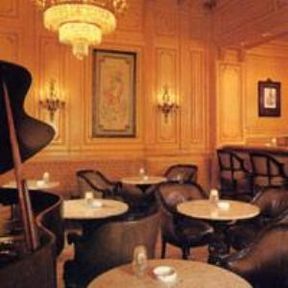
Plaza Bar, Westgate Hotel, San Diego
About this crowded when I arrived.
Banquettes extend down the walls of a long narrow room behind the phographer.

The pianist was a very friendly gent and we got to talking about the Great American Songbook, what are usually called "standards."  I'll spare you the details, but, as sometimes happens, the pianist asked me to sing a song or two.  That was a pretty low-risk proposition, since the audience consisted solely of the two very elderly people sitting on the banquette.  I think I sang "The Shadow of Your Smile" and "The Days of Wine and Roses."  Maybe "That's All." 

The pianist said, "You should stick around for Julio."

The elderly couple on the banquette beckoned me over, thanked me for the songs.  "You should stay for Julio," the old man said.


Piano, Plaza Bar, Westgate Hotel
Picture this singer (Karen Giorgio) as a slender
Italian guy who looked a little like Montgomery Clift.

By that time, the pianist's shift was over and he was packing up his stuff.  "Julio starts at 7," he said.  "This place will start filling up soon."  He closed the piano and covered it.

And sure enough, maybe a quarter to, people began to arrive at the bar.  Just a few at first, and then a steady stream.

A steady stream of Mexicans.

PART 2 of this meandering anecdote will appear on Thursday.