Showing posts with label CV-19. Show all posts

Tuesday, May 26, 2020

Finally, Congress Can Make Itself Useful During the Contagion Reopening

Here's a poser for those of you who follow things not getting much attention these days, like, oh, constitutional limitations on the power of Congress:

Why is the federal government not challenging the authority of the states to set rules with respect to the conduct of business during The Contagion?  It seems to be a given that governors (on down) have the authority to say who can be open, who can't.  Who can go to work, who can't.  Who can leave their homes to buy things, who can't.  Even Donald Trump, the latest in a long line of presidents most vividly illustrated by the last one we had, who thinks that there is no meaningful limit on what the federal government can do, finds himself in the position of "urging" state governors to accelerate reopening.

It may come as a surprise to some, but the U.S. Constitution actually sets forth the matters upon which "the Congress" may exercise power.  Supposedly, that's it.  However, over the centuries -- actually, over the last century-plus -- when faced with whether a particular Congressional assertion of authority in passing laws is before them, the Supreme Court has fastened on what is known as the Commerce Clause.  It is found in Article I, Section 8, Clause 3, and it goes like this:  Congress has the power

to regulate Commerce with foreign nations, and among the several States, and with the Indian Tribes.

I'll spare you the history and the nuances, but suffice it to say that the Supreme Court has read this phrase as authorizing any federal legislation that substantially affects interstate commerce.  That, I'm sure you can surmise, covers a lot and a lot and a big lot of laws that you would never think rose to the specificity of "regulating" interstate commerce. 

I'm not here to argue the wisdom of that interpretation or that many legislative sins have been forgiven in the name of that sweeping interpretation favoring Congressional authority.  Only that that is the current state of Commerce Clause law, and it isn't going anywhere anytime soon. 

James Madison's quote at the end of this essay to the contrary.  Sorry, Jim. 

So here's the question:

Let's assume, as seems to be the case, that there is a growing consensus in Washington (and everywhere that people breathe free, not to bias the discussion here) that a continuation of the shutdown, whatever its merits in mid-March, is -- when viewed with the best available science and numbers -- unjustifiable in late May and going forward; that the increased risk of infection and mortality is more than balanced by the need to get businesses open, get supply chains re-lubricated, get unemployment claims down, get life in general back to normal.

Again -- I'm not here to argue whether this calculation is justified, or moral, or a threat to the old folks.  It is not my intention to gig the no-economic-price-too-high-to-save-lives crowd.  I only want to consider who has the authority to act.

Go back and read that text of the Commerce Clause, and bear in mind that it is beyond current question that it authorizes any law that "substantially affects" interstate commerce, which is essentially all commerce of any noticeable economic substance.

You do not have to stretch that interpretation to see that it would plainly authorize a statute that entirely leapfrogged governors, mayors, and any other non-federal authority to require, or at least not issue orders against, reopening.  No, not even the Ninth Circuit, not even Laurence Tribe, would conclude that a federal enactment specifically aimed at attempting to reverse the slagging of the entire American economy would "regulate commerce among the several states." 

I don't know what exact shape that legislation would take.  Me, I'd add some filigree to it, like a tort-reform provision protecting employers and businesses from reopening-related liability, and I'd make it retroactive to the beginning of The Contagion.  I might build in some permissive local authority to let the local pols have some flexibility to look like they're doing something useful.  But what the law should not tolerate is gubernatorial fiat visiting further destruction on state economies.

The Tenth Amendment, sometimes urged as a hedge against federal overreaching, is not helpful to the governors here.  It provides:

The powers not delegated to the United States by the Constitution, nor prohibited by it to the states, are reserved to the states respectively, or to the people

Doesn't work here, because the Commerce Clause describes "powers delegated to the United States by the Constitution."

If properly-tailored legislation -- that is to say, legislation that didn't have some kind of prohibited secondary purpose or purport to overreach -- were introduced in Congress aimed at ameliorating the damage to the U.S. economy caused by the reaction to the coronavirus threat, no court could declare it unconstitutional without entirely upending decades of Commerce Clause interpretation.

Which, come to think of it, would not be such a bad idea. 

So it's a win-win.

*      *     *
 
NOTE:  Now that we know the shocking economic damage done by the state-by-state shutdown orders, I suggest that the foregoing analysis would also give Congress the authority to occupy the entire subject-matter area of the conduct of economic activity during times of contagion, giving it authority to override state authority to order shutdowns in the first place.  This gets into things like the "dormant commerce clause," the ability of states to legislate in the absence of congressional intent to preempt an entire area of legislation, and other technical issues I do not propose to discuss here.

 
[PS:  I have put aside whether any legislation proposed by this administration, irrespective of its merits, could pass the House at this time.  Its mere introduction would separate those who favor the continued constraints on freedom for opportunistic and/or "scientific" reasons, from those who favor starting to bake the risks of infection and death into the economic system, as all human activities involving risk (i.e., all human activities) already have been.
 
Don't get me started on executive orders.]
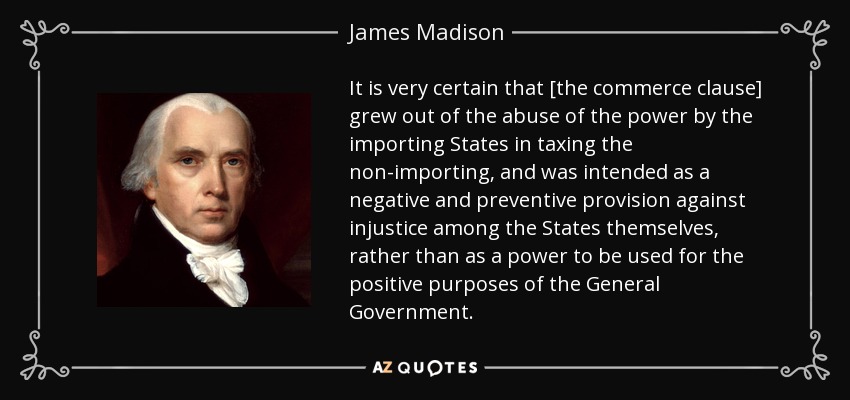
 
James Madison quote: It is very certain that [the commerce clause ...


CoolHotCenter@gmail.com
@CoolHotCenter
 
Please share this post with interested persons.


Wednesday, April 29, 2020

How Would I Feel if a Loved One Died of COVID-19 after Re-Opening?

Some online commenters, rather a lot, say that re-opening the economy and ending enforced social distancing is wrong if it causes any increase in the mortality rate, and by the way, how would you feel if it were your loved one dying of the Great Contagion of 2020?

First, let us grant that we continue to get a pantload of conflicting information about every aspect of this disease and its management.  It is very difficult to know whether re-opening is the right thing to do.  Federal state and local officials say some smart and empathetic and cool-headed things, and some stupid and thoughtless and nonsensical things.  Our formerly ethical press has not helped matters with its poor and sensationalist reportage.  When the story of The Contagion is written, there will be the usual heroes and villains around the world.  We'll have to wait for that.

Second, let us grant that it is very appealing to think that human life is more important than money.  How much more important?  That we can think about.

We think about it every day, whether we're aware of it or not.

In fact, we do not live our lives in a way that reduces the risk of death at any cost.  We balance risk with commerce every day.

--  We don't social distance for ordinary seasonal flu. 

--  We don't drive 35 on the highways instead of 65.

--  We don't forbid the sale and use of alcohol. 

We don't do these things, and many others, because the common sense of the populace is that the risk of death and illness is outweighed by the benefits of allowing seasonal flu to take its course, driving 65 on highways, and drinking alcohol, even though the death toll from those choices is huge and could be hugely reduced with the suggested restrictions.  The risks of ordinary life are already baked into the health care system, the tax system, government spending, all infrastructure, commercial activity, and laws governing all manner of conduct, not to mention the common sense that guides us in our daily lives.

It is obvious that there is a point where as a society we must be willing to trade normal human activity (that is, the avoidance of economic collapse)  for the risk of increased mortality -- remember we're not talking about all CV deaths, only the ones that have been avoided so far by the shutdown -- that would result from the easing social distancing rules and allowing businesses to open and people to gather. 

So how would I feel if a loved one died of CV after re-opening?  Real damned bad.  But I would feel the same way I would feel if one died in a car accident going 65 when she wouldn't have died if the speed limit were 35.   We can't sacrifice a world economy for the sake of any single individual (or some number greater than a single individual), and whether any are related to you is of no moment.

Of course, there is a fulcrum at which marginal deaths -- that is the increased deaths from reopening -- are so numerous that you are willing to kill a lot of the economy for a long period of time.   What is that number?  It isn't one, and it isn't a dozen, and it isn't several hundred.  How about 10,000? 

Is it OK to have a years-long depression for to avoid 10,000 additional deaths?   Maybe, maybe.  But what about the deaths caused by the shutdown?  Caused by widespread economic depression?  Caused by civil unrest when people have had their fill of house arrest?   Today's news brings articles about hospitals suffering enormous COVID-19-related losses that threaten their continued operation.  

I admit, it's a tough call.  And it sounds awful to say it, but it is not -- marginal deaths are an acceptable price for the resumption of ordinary life. 

There comes a point at which sentiment needs to be suppressed for the good of civil society, and we have reached that point.   Re-opening should be undertaken in a sensible fashion with the full knowledge that some will be infected who otherwise would have avoided it.

And if you disagree -- you can stay home or be unemployed if it suits you. 

That's part of civil society, too.

Report: 3 killed in Oakdale-Waterford Highway CA crash | Modesto Bee

CoolHotCenter@gmail.com
@CoolHotCenter
 
Please share this post with interested persons.

Thursday, April 16, 2020

Some Early Thoughts on the Reopening

I'm trying to work through the implications of easing of the shutdown, which easing appears to be coming, whether through government edict or growing civil disobedience. I need the more epidemiologically inclined among us to help me out here, but I keep coming back to this train of thought:

(1)  The Contagion is still active among us.  Still out there infecting people as it always has.  (I learned of my first "positive" acquaintance yesterday; he's fine and over it after self-quarantining.  He reported it was like "a bad flu.")

(2)  The shutdown and enforced social distancing have been effective in keeping the mortality rate lower than it would have been without those rules.

(3)  With restrictions loosened, the death rate will increase, if not "spike."

(4)  In fact, depending on how much reopening takes place, we will be returning to a civil order in which the death rate will approach what it would have been had there been no loosening to begin with. That is, since we are assuming The Contagion is still active, people will be exposed to the same degree as they would have been had there been no shutdown.

(5)  Which means that leaders and citizens are willing to tolerate the increased number of deaths and the risk to themselves in order to get their lives, and society's general health, back to something approaching what they were before the shutdown.

(6)  Which in turn suggests that the shutdown accomplished little or nothing and was almost solely destructive.  Put another way:  If The Contagion returns with anything like its initial ferocity, then the only difference between not shutting down early and reopening now is that in the meantime we severely damaged the economy and suffered the many other ills identified with social isolation.

What would make this analysis wrong is if the prophylactics of the past couple of months make it far less likely that deaths will increase to the level they would have reached without them. I haven't seen a suggestion of this anywhere, but one can envision a way that this could be the case. Perhaps, for example, it has forestalled deaths while progress has been made toward a vaccine/cure and that "flattening the curve" for this period of time (if that has in fact been its benefit) will result in fewer deaths in the long run. Again, I have not seen this as a justification for the shutdown, but it's possible; if the shutdown will have materially decreased total deaths by the time this has passed, then the foregoing chain of reasoning is weakened.

This train of thought also may wrongly assume that the loosening will return us all the way to pre-loosening freedom. If loosening is not total, deaths may not return to the "worst-case" non-loosening levels, but will increase to some material degree. So even if the analysis  overstates the danger for this second reason, it still suggests that the shutdown was too severe because it did not sensibly balance the economy/social order and the mortality rate; we're willing to tolerate some trade-off.

I concede there is some unfairness in this line of thinking.  We were uncertain of the lethality of The Contagion, so it is difficult to blame policymakers for acting decisively to be on the safe side. But at least based on what we know about decisionmaking in this case (which, of course, may be quite incomplete), this kind of balancing wasn't even considered by policymakers. Radical prevention entirely supplanted intensive fact gathering that might have permitted the kind balancing we are apparently now willing to undertake.

*     *     *

A final toss-off thought:  If the majority of the population accepts the new freedom/death rate trade-offs that loosening represents, whom does it help in November? There seems to be a right/left divide emerging on the issue of economy rescue versus every-life-worth-every-sacrifice. Depending on how it's handled by both federal and state officials, and assuming the spike in deaths is not too horrifying, I think it helps Trump and Republicans.

Perhaps not much, and perhaps not enough to preserve Trump's incumbency.  But that's a topic for an upcoming column.


*     *     *


I welcome correction on any of the medical or epidemiological errors in the foregoing.  I would love to publicize anything that points to a less gloomy conclusion on (1) what will happen to the death rate on reopening and (2) whether the shutdown will have accomplished anything if reopening results in a material increase in deaths.


CoolHotCenter@gmail.com
@CoolHotCenter

Please share this post with interested persons.

Saturday, April 4, 2020

Some Further Fatuities on the Response to The Contagion


I will here describe a way of thinking about the response to CV-19 that much smarter and more knowledgeable scientists, doctors, actuaries, economists, statisticians, and politicians – and, I suggest, philosophers – might at least be thinking about thinking.  (Not to distance myself too obviously from what follows.)


Assumption #1:  It is tragic when people die and more tragic when they die before they should actuarially be expected to – for example, from a novel virus for which there is no vaccine or cure.  The strain on the healthcare system itself risks deaths from other causes for which treatment is unavailable owing to the crush of CV-19 cases.


Assumption #2:  It is also tragic, and can lead to fatalities of its own, when the leading economic power in the world is thrown into an artificial depression with misery for millions and no real strategy in sight to lift it.  The deprivation and unrest are themselves horrors, and just as unjust.


Assignment:  What level of death can we tolerate to avoid economic catastrophe?*


*  I will assume for the time being that an illness not resulting in death in the usual case would not have produced the current lockdown, although given the media’s panicked reporting, I’m not entirely sure about that.  So I will focus on deaths while understanding that non-fatal infections also cause pain to victims and the healthcare system.

To ask the question may seem cold-blooded.  Assumption #2 contains the subassumption that the damage to the economy and the population at large from a near-full shutdown of indefinite duration, which is where we seem to be heading at this writing, would be catastrophic:  At a minimum a classic deep depression, this time around possibly accompanied by social unrest and even violence in a population unaccustomed to privation and full of confidence about its "rights."  Is this assumption correct?  If it is not, you may stop reading now.   There is at least the strong possibility that the currently contemplated measures would yield a national condition that is itself very bad, so bad that it is at least worth thinking about how it balances with the deaths to be expected from the contagion.  So let’s think about it.

As of today, the numbers provided by reputable websites (Johns Hopkins among them) yield about the same U.S. death rate:  2.7% (8,098/297,575).  For seasonal flu, it is much less than 1%.  Worldwide, the CV-19 death rate is about 5.4%, depending on what you think about the accuracy of foreign (e.g., Chinese) reporting.

The R0 (number of persons estimated to be infected by an infected person) is unknown with precision, but since it is certainly greater than 1, the disease can be expected to spread – it won’t die out naturally.  The number most recently seen is about 2.5, which is higher than regular flu.  The thing is highly infectious; it isn’t going to go away on its own, and it is more lethal than regular flu.

Current forecasts of deaths in the United States under these circumstances vary.  In February, the Centers for Disease Control ran a series of scenarios and came up with an unhelpful estimate of from 200,000 to 1.7 million deaths.*  The same article quotes another expert as estimating 480,000 deaths. 

It is hard to know what to make of these estimates.  “At the outset of the H1N1 swine flu outbreak in 2009, President Obama’s Council of Advisors on Science and Technology predicted that the virus would result in 900,000 to 1.8 million hospitalizations and 30,000 to 90,000 deaths. Actual figures a year later were to be 274,000 hospitalizations and 12,000 deaths.”

*  https://thehill.com/opinion/healthcare/488494-estimating-coronaviruss-us-toll; March 19, 2020.  This article estimates far fewer deaths.  

Which is what makes essays like this fatuous.  I have no idea how many U.S. deaths to expect.  A lot.  And a crushing burden to the healthcare system.

It is no comfort to compare The Contagion to seasonal flu.  The sites I have visited estimate this year’s influenza A and B death toll to be anywhere from the low- to mid-five figures.  And the health system is already equipped to handle those.

At first blush, one might conclude:  Based on current estimates and our current understanding of the disease, CV-19 is much more deadly than seasonal flu and justifies the economy-depressing measures being taken.

But let’s come at this from a slightly different angle.  Consider the infection rates upon which the worst-case scenarios are based – the ones that have stopped us all down:  Those February CDC scenarios I cited above assume the infection of between 160 to 214 million people.  (Fatuity alert:  I don’t know if those numbers take any degree of any of the current preventive measures into account.)  The current population of the U.S. is 330 million.  The estimate assumes that half to about 65% of the citizenry will be infected.  According to an article posted a couple of days ago reporting on a late-March article from Lancet Infectious Diseases, the infection rate is about 50% (again, effects of prophylactic measures unknown).


Which would lead me to ask the experts I assembled in the first paragraph of this essay the following question:  How would the infection rate differ if we (1) had no restrictions of any kind in place, or (2) allowed a substantial but not total resumption of normal economic activity?  Would it be a whole lot worse than 50-65%?  

The question is:  Would it be so much worse that the increase in deaths justifies the shutdown of the American economy with its attendant miseries, including health-related problems, possible civil unrest, and, quite probably, an increase in non-CV-19 deaths?*

*  I won’t get into the question of who is most at risk here – who is more likely to die.  I’m assuming that the lives of elderly and health-compromised persons who are at greater risk are of equal value to those of younger or healthy persons (who are at some risk themselves).


The revival of the economy would not have to be total.  Here’s a suggested half-measure program:
  • Keep schools closed.
  • Maintain the moratorium on organized sporting activities, including professional sports.
  • Maintain a moratorium on stadium-auditorium-theater entertainment.
  • Permit all other economic activity, including restaurants, and all retail, all manufacturing, supply, and service activity; that is, it is voluntary.
  • Where feasible, require social distancing as many grocery stores are now doing.
  • Require masking for certain activities, perhaps most activities; perhaps something close to all-mask-all-the-time when one leaves one’s residence  for any purpose (you can unmask to eat), including employment.
  • Pass laws necessary to assure that all persons who do not self-quarantine, and all persons choosing to work for employers that choose to do business, assume the risk of infection; that is, all civil liability for transmitting the disease is eliminated except for intentional transmission.  I would also protect employers and merchants from civil rights suits for excluding symptomatic persons from the workplace or establishments (unless pretextual to disguise forbidden discrimination).
The analysis becomes, crudely: 

Projected infection rate from liberalization of economic activity minus current infection rate, times 330 million, times 2.5% = estimated number of additional deaths.  Crudely, because, among many other imponderables, that 2.5% might go up as the strain on the healthcare system increases.

But you’re not done, because you have to assume that the vast depression that would result from the full-measure shutdown would cause a certain number of deaths that will now be avoided.


But you’re still not done, because the revival of the economy (to the extent permitted with the foregoing half-measure proposal) will bring with it other benefits:  economical, psychological, governmental, hedonic, maybe even spiritual, while we all take a deep breath and gut out the higher mortality rate from CV-19 during the half-measure phase. (And don't forget that we need to check the assumption that a shutdown would be the disaster I'm assuming.)*

*  Remember:  all models are suspect.  Dr. Fauci:  "There are things called models, and when someone creates a model, they put in various assumptions. And the model is only as good and as accurate as your assumptions," he said. "And whenever the modelers come in, they give a worst-case scenario and a best-case scenario. Generally, the reality is somewhere in the middle. I've never seen a model of the diseases that I've dealt with where the worst-case scenario actually came out. They always overshoot."
So if you are thinking carefully about the full shutdown that seems to be approaching, you are comparing:

a numerically large, percentage-wise small, number of human lives

     with

certain hardship, sometimes severe, sometimes fatal, for close to 100% of millions that will likely outlast the pandemic. 

I state that prejudicially, but I acknowledge that it is a very hard choice because human life is very, very valuable.  But the choice should be considered.  As noted, people much smarter and better-informed and devoted than I sitting in my compression shorts and rash shirt for a few hours on a Saturday afternoon might usefully do the arithmetic and sound much less fatuous reporting on it.    

And, by the way, if my numbers are wrong -- what are the right ones?  If the current projections are not as dire as reported, then how less dire are they, and how does that change the lockdown analysis?  If the infection rate is more dire, doesn't that shift the analysis toward easing, rather than intensifying, the lockdown?  Whatever the numbers are, the question remains the same:  Is the death-delta from coercive-lockdown versus something-considerably-less-than-coercive-lockdown an acceptable price for the potentially huge damage to the economy and social order?

Too cold-blooded for you?   Come see me in a month.  If you can find a sitter.


CoolHotCenter@gmail.com
@CoolHotCenter